
Vadzo Imaging Validates Onvif Profile S, T, and G on Innova-234MGS AR0234 2MP Monochrome Gigabit Ethernet Camera for Patient Monitoring Applications
Built for continuous patient monitoring and clinical imaging that must resolve motion accurately without adding heat or

Press Release Disclaimer: This is a press release distributed through the XPR Media network. It has not been independently verified by our newsroom.


Built for continuous patient monitoring and clinical imaging that must resolve motion accurately without adding heat or complexity to a patient room, this camera pairs the Onsemi AR0234 global shutter sensor with Onvif compliance and low operational power over GigE Vision, giving healthcare technology providers dependable monochrome imaging that integrates directly with hospital network infrastructure already in place.
FORT WORTH, TX / ACCESS Newswire / August 27, 2026 / Vadzo Imaging, a world leader in embedded vision solutions, today announced the validation on onvif profile S, T and G on the Innova-234MGS, a 2MP Monochrome GigE Camera built around the Onsemi AR0234 global shutter sensor for continuous patient monitoring, clinical imaging, and hospital network integration applications that need motion-accurate video and low operational power across a multi-room deployment.
Why Patient Monitoring Needs a 2MP Monochrome GigE Camera Built for Motion Accuracy and Scale
Continuous patient monitoring depends on video that resolves genuine patient movement accurately, whether that movement is a clinically relevant change in position or a subtle motion a care team needs to notice quickly. A camera using a rolling shutter sensor exposes each row of a frame at a slightly different moment, which introduces a skewing effect on anything moving during that exposure window, distorting the exact motion detail a monitoring system depends on to work correctly.
An AR0234 sensor built around global shutter capture approaches that problem by exposing the entire frame at the same instant, which matters directly for monitoring applications where motion accuracy cannot be compromised by sensor architecture. A 2MP Mono GigE Camera configuration like this one gives healthcare technology providers a camera built specifically around this motion accuracy requirement rather than adapted from a security application where it matters less.
A second, more practical challenge is deploying that camera across dozens or hundreds of patient rooms without a corresponding increase in electrical infrastructure or heat generation inside each room. A 2MP Low Power GigE Camera addresses that scale problem directly, since even a modest reduction in per-unit power draw compounds meaningfully across a hospital-wide deployment.
Neither challenge exists in isolation on a real hospital floor. A camera that resolves motion accurately but draws excessive power is not actually practical to deploy across an entire hospital, and a camera that saves power but distorts patient movement is not solving the clinical problem monitoring exists to address in the first place. Addressing both from the same sensor platform is what makes a camera genuinely suited to hospital-wide patient monitoring rather than merely adequate on a single specification.
Engineering Explanation: Motion Accuracy, Sensitivity, and Interoperability Together
Onsemi designed the AR0234 as a global shutter sensor specifically for applications where motion accuracy matters more than the simpler pixel design a rolling shutter sensor allows. As an Onsemi AR0234 GigE Camera, the sensor exposes its entire pixel array at the same instant, producing a geometrically accurate frame regardless of what is moving within it, which matters directly for patient monitoring where a care team needs to trust that what they see reflects what actually happened rather than a shutter artifact.
Monochrome sensitivity works alongside that global shutter architecture rather than as an unrelated feature. As an AR0234 Mono GigE Camera, the sensor captures more usable light per pixel than a color equivalent, since there is no color filter array absorbing a portion of incoming light before it reaches the photodiode. An AR0234 Mono Gigabit Ethernet Camera configuration like this one gives clinical imaging applications where color information is not diagnostically necessary a genuine sensitivity advantage in typically dim patient room lighting.
ONVIF compliance is what makes this sensor deployable across a hospital’s existing infrastructure rather than as an isolated point solution. As a 2MP ONVIF Gigabit Ethernet Camera, the Innova-234MGS integrates directly with the video management and monitoring systems a hospital already runs, rather than requiring a separate app or proprietary viewer. An ONVIF Gigabit Ethernet Camera configuration like this one gives hospital IT departments confidence that a new camera will behave like every other ONVIF device already on the network.
Low operational power is the final piece of the design, and it matters specifically at hospital deployment scale. As an AR0234 Low Power Ethernet Camera, the Innova-234MGS draws meaningfully less power than a comparable sensor not built around that specific efficiency goal, and a Low Power GigE Sensor configuration like this one reduces both the electrical infrastructure and the heat generated inside a patient room, which matters directly for spaces where excess heat is not just an inefficiency but a genuine patient comfort concern.
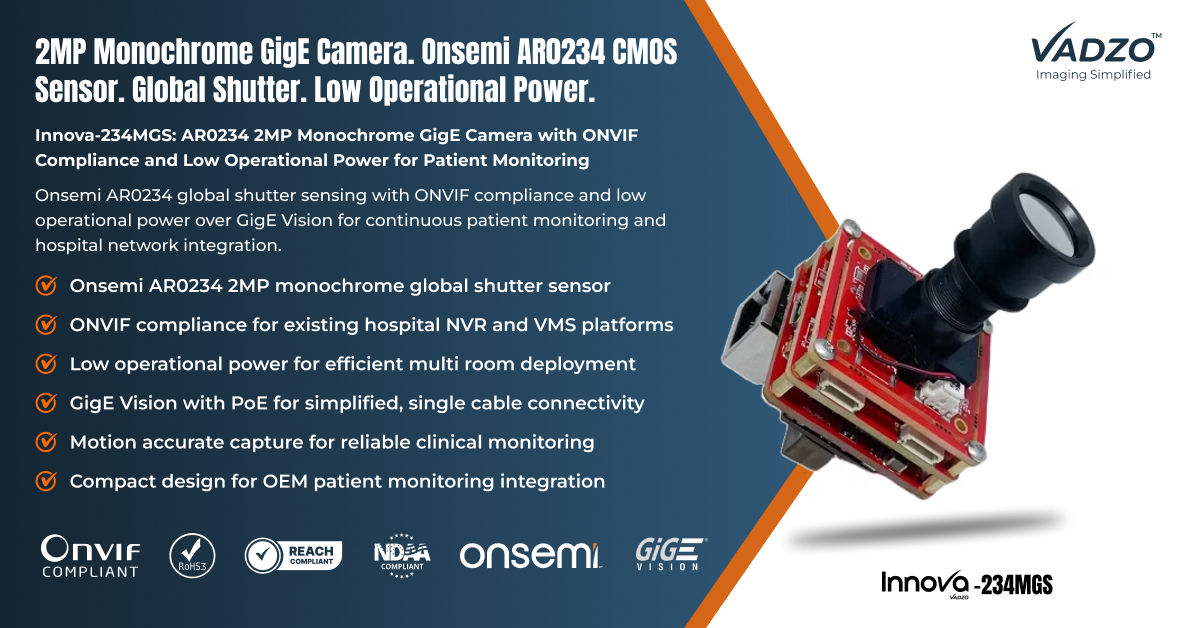
Product Overview
The Innova-234MGS pairs the AR0234 Monochrome Ethernet camera sensor with ONVIF compliance and low operational power in a compact design suited to patient rooms, ICUs, and general hospital monitoring integration. As a 2MP Monochrome GigE Camera, it outputs full 1920 x 1200 resolution with global shutter capture and low-power processing active by default, giving healthcare technology providers a single camera platform that covers continuous monitoring, motion detection, and general-purpose clinical imaging from one module.
At the core of the module sits the Onsemi AR0234 GigE Camera sensor, chosen specifically for the combination of motion accuracy and power efficiency that hospital-wide deployment requires. As an AR0234 Gigabit Ethernet Camera, it connects directly to standard hospital network infrastructure. Because the camera pairs 2MP Gigabit Ethernet Camera Module connectivity with 2MP ONVIF PoE Camera compliance, the Innova-234MGS integrates directly into existing hospital network and video management infrastructure without requiring a specialized viewer or a separate monitoring application.
Product Specifications
Key specs: 2MP (1920 × 1200) | Onsemi AR0234, 1/2.6-inch | 3.0 µm Pixel | Monochrome | Global Shutter | GigE (Gigabit Ethernet) Interface | S Mount (M12 Standard) with Auto Switch IR-Cut Filter
Key Capabilities
Onsemi AR0234 Global Shutter Sensor for Motion-Accurate Patient Monitoring: The Innova-234MGS is built around the Onsemi AR0234 sensor, a global shutter device that exposes its entire pixel array at the same instant rather than scanning row by row. This gives the module genuine motion accuracy suited to patient monitoring applications where a care team needs footage that reflects what actually happened, not a distortion introduced by the sensor’s own readout method. That distinction matters most during exactly the moments a monitoring system exists to catch, when a patient’s position or condition changes and the recorded footage needs to reflect that change accurately rather than smearing it across several frames.
Monochrome Sensitivity for Low Light Clinical Imaging: Patient rooms are typically dimmed during rest periods and overnight hours, which is exactly when continuous monitoring often matters most. As a 2MP Monochrome PoE Camera, the Innova-234MGS captures more usable light per pixel than a color equivalent, giving clinical imaging applications genuine sensitivity in typical patient room lighting conditions without requiring supplemental illumination that could disturb a resting patient.
ONVIF Compliance for Interoperability with Existing Hospital Systems: A camera built on a closed or proprietary protocol becomes an isolated point solution rather than a working part of a hospital’s existing video management infrastructure. As a Monochrome PoE Camera Module, the Innova-234MGS speaks the ONVIF standard that hospital IT departments already manage, so a new camera can be added to an existing monitoring system the same way any other standard device would be. As a Monochrome GigE Camera Module, it is also available as a standalone module for integrators building their own housing or mounting solution around the sensor.
Low Operational Power for Efficient Continuous Monitoring: A single camera’s power draw is a minor consideration in one patient room, but a hospital deploying that same camera across dozens or hundreds of rooms multiplies that draw by the size of the entire deployment. As a 2MP Low Power Ethernet Camera, the Innova-234MGS reduces that cumulative power and heat load, which matters directly in patient rooms where excess heat is a genuine comfort concern rather than a minor engineering inefficiency.
GigE Vision and PoE for Simplified, Long-Distance Connectivity: Hospital wiring infrastructure varies significantly between older and newer buildings, and a camera that requires a dedicated power run in addition to a data connection adds real installation cost across a multi-room deployment. GigE Vision with Power over Ethernet carries both video and power over a single cable, which simplifies installation in exactly the kind of mixed vintage building infrastructure a large hospital campus typically presents. That single cable approach also reduces the number of points of failure at each camera position, since there is one connection to test and maintain rather than separate power and data runs that could each introduce their own reliability issue over time.
Compact OEM Ready Design for Medical Device Integration: Patient monitoring equipment manufacturers producing units at scale need a camera platform that stays consistent across a long production run. Vadzo Imaging supports full customization on this platform as an OEM Low Power GigE Module, including connector changes, housing design, and firmware adjustments for manufacturers headed into regulated volume production. That customization extends to power profile tuning as well, since a manufacturer building equipment for a general patient room may need a different balance of sensitivity and power draw than one building equipment for a critical care unit, even though both rely on the same underlying sensor.
“Care teams need to trust that what they see on a monitoring feed reflects what actually happened, not a distortion introduced by the camera itself. The AR0234’s global shutter combined with ONVIF compliance and low operational power gives the Innova-234MGS motion-accurate video that integrates directly into a hospital’s existing systems, without adding meaningful power or heat load across a multi-room deployment. We built this camera for deployments measured in hundreds of patient rooms, not a single pilot unit.” – Alwin Vincent, Product Manager at Vadzo Imaging.
Application
Continuous Vital Sign and Motion Monitoring: Continuous patient monitoring depends on resolving genuine patient movement accurately enough to support clinical decisions, which is exactly where a global shutter sensor’s motion accuracy matters most. As a Bedside GigE Camera, the Innova-234MGS delivers that accuracy directly at the bedside, and its monochrome sensitivity holds up through the dimmed lighting typical of overnight monitoring. As a PoE Patient Camera, it draws both power and data over the same cable already running to most bedside monitoring positions.
Hospital Network Integration via ONVIF and GigE: Hospital IT departments need new monitoring camera products to integrate directly with existing network and video management infrastructure rather than requiring a separate, proprietary system. As a Wired Patient Monitoring Camera, the Innova-234MGS’s ONVIF compliance and GigE connectivity fit that existing infrastructure, and a Network Attached Patient Camera configuration of the same module integrates directly with a hospital’s established network architecture. As a Gigabit Ethernet Patient Camera, it connects using the same standard networking equipment a hospital’s IT team already deploys and supports.
ICU and Critical Care Monitoring: Itensive care and critical care monitoring depend on continuous, motion-accurate video that a care team can trust without question during time-sensitive decisions. A Clinical GigE Vision Camera built on this platform delivers that trustworthy accuracy, supporting both continuous observation and documentation needs in a critical care setting. That documentation value matters beyond the immediate monitoring task, since accurate footage can also support care team communication and review after a critical event has already passed. As a Hospital ONVIF GigE Camera, it integrates directly with the ONVIF-compliant recording infrastructure most critical care units already rely on.
Low Power Multi Room Hospital Deployment: Hospitals deploying camera units across dozens or hundreds of patient rooms need a platform where per-unit power draw genuinely matters at that scale, both for electrical infrastructure and for heat generated inside each room. As a Low Power Hospital Camera, the Innova-234MGS supports that kind of large-scale deployment without a corresponding increase in a facility’s electrical or cooling demands. As an Ethernet Patient Camera Module, it fits directly into a facility’s existing wired network infrastructure without adding separate power distribution to every room.
OEM Integration for Patient Monitoring Equipment Manufacturers: Patient monitoring equipment manufacturers building their own hospital hardware need a camera vendor who understands the motion accuracy, interoperability, and power requirements those systems demand. The Innova-234MGS ships with those requirements built in, and Vadzo Imaging supports OEM customization for cable length, connector type, and firmware for manufacturers standardizing on one camera across multiple patient monitoring product lines. As a GigE Vision Patient Module, it fits directly into a manufacturer’s existing platform architecture. As a Gigabit Ethernet Camera for Healthcare, it ships from a vendor with regulated healthcare deployment requirements already built into the design process.
Frequently Asked Questions
Q: Why does a global shutter matter specifically for patient monitoring rather than general hospital surveillance?
A: Patient monitoring often depends on resolving specific, clinically relevant movement accurately, whether that is a change in position, a repositioning event, or a subtle motion a care team needs to notice and document correctly. The Innova-234MGS is built around exactly this requirement, pairing the Onsemi AR0234’s global shutter capture with monochrome sensitivity for clinical use. A rolling shutter sensor exposes each row of a frame at a slightly different moment, which can distort exactly that kind of motion detail in ways that matter far more for clinical documentation than for general area surveillance where a small amount of motion distortion is rarely consequential. Vadzo Imaging selects global shutter sensors for its patient monitoring camera products specifically because clinical use raises the bar on motion accuracy well above what a general surveillance application typically requires. A camera that performs adequately for general area observation is not automatically suited to a clinical task where the specific nature of a movement, not just its general presence, may carry real diagnostic or safety significance.
Q: Why would a hospital choose a wired GigE camera over a wireless camera for patient monitoring?
A: Wireless connectivity offers real installation flexibility, but a hospital environment also runs a considerable amount of other wireless equipment, from patient monitoring devices to staff communication systems, all competing for the same limited spectrum in a setting where a dropped or degraded video connection is a genuine clinical concern rather than a minor inconvenience. A wired GigE connection avoids that shared spectrum entirely, delivering a consistent, dedicated connection that does not depend on radio conditions that can change as more wireless devices are added to a floor over time. Vadzo Imaging offers its patient monitoring camera products in a wired GigE format specifically for facilities and applications where that connection reliability matters more than wireless installation convenience. Facilities weighing this choice should consider not just current wireless conditions but how those conditions are likely to change as more connected devices are added to a floor over the life of the monitoring system.
Q: How does low operational power benefit a hospital deploying many camera units across multiple patient rooms?
A: A single camera’s power draw is a minor consideration in one room, but a hospital deploying that same camera across dozens or hundreds of patient rooms multiplies that draw by the size of the entire deployment, which shows up as a real, recurring cost in both electrical infrastructure and cooling capacity. This is the deployment scale the Innova-234MGS was engineered around, drawing meaningfully less power than a comparable sensor not built with that efficiency goal in mind. Lower power draw also means less heat generated inside each individual patient room, which is a genuine comfort consideration in a space where a patient may be resting for extended periods. Vadzo Imaging designs its patient monitoring camera products around genuine low operational power specifically because that scale effect is predictable and significant across a hospital-wide deployment, not a marginal specification that only matters in isolation.
Q: Can Vadzo Imaging customize a monochrome GigE camera module for a specific patient monitoring platform?
A: Yes. Vadzo Imaging supports full OEM customization across its patient monitoring camera portfolio, including housing design suited to a specific mounting position, connector and cable configuration matched to a particular hospital network architecture, and firmware adjustments tuned for a specific power or ONVIF configuration profile. Evaluation units ship with no minimum order requirement, and the same engineering team that built the standard product works directly with patient monitoring equipment manufacturers to adapt the module for a specific hospital or clinical platform headed into regulated production.
Q: What should healthcare technology providers look for when choosing a camera supplier for a hospital-wide patient monitoring deployment?
A: A hospital-wide deployment depends on consistency across every camera and every room, since a camera that performs inconsistently between units introduces uncertainty into a monitoring system that clinical staff needs to trust without question. The Innova-234MGS, with its ONVIF-compliant GigE Vision connectivity and Onsemi AR0234 sensor, was built around meeting that consistency requirement at scale. Providers should look for genuine motion accuracy validated under real patient room conditions, ONVIF compliance that integrates with existing hospital network infrastructure rather than requiring a separate system, and a supplier able to maintain consistent hardware and firmware across a long, multi-year deployment. Vadzo Imaging builds its patient monitoring camera products around exactly these priorities, since a camera that performs well in a single pilot room is not necessarily ready for a true hospital-wide rollout. Requesting performance data from a variety of room types and lighting conditions, rather than a single well-controlled pilot location, is generally the more reliable way to confirm a camera will hold up across the full range of conditions a real hospital campus presents.
Availability
The Innova-234MGS 2MP Monochrome GigE Camera is available now for evaluation and OEM integration. Evaluation kits include the camera module, mounting hardware, and integration documentation covering ONVIF configuration and power profile setup, with no minimum order requirement. Contact Vadzo Imaging at support@vadzoimaging.com to request an evaluation unit or discuss volume production and OEM customization. Evaluation feedback is also welcome directly through the same contact channel, since real hospital deployment conditions often surface details a bench test alone would not reveal.
About Vadzo Imaging
Vadzo Imaging develops embedded and machine vision camera products for OEMs, system integrators, and healthcare technology partners building production-ready vision systems across patient monitoring, clinical diagnostics, security, and edge AI. The company’s portfolio spans MIPI CSI-2, USB, GigE, Wi-Fi, FPD-Link III, and SerDes interface camera products, supporting deployment architectures from compact onboard modules to distributed networked installations. Vadzo provides end-to-end imaging support, including sensor integration, ISP tuning, firmware development, and SDK frameworks to accelerate system deployment, and the company’s engineering team works directly with customers throughout evaluation, pilot deployment, and volume production rather than handing off support after the initial sale. That ongoing engineering relationship matters most for healthcare programs, where a camera platform may remain in service across an entire hospital’s patient monitoring infrastructure for many years after initial installation. Visit Vadzo Imaging to explore the full embedded vision camera portfolio.
Media Contact
Alwin Vincent
Vadzo Imaging
Email: alwin@vadzoimaging.com
LinkedIn: Vadzo Imaging
YouTube: Vadzo Imaging
X: Vadzo Imaging
SOURCE: Vadzo Imaging
View the original press release on ACCESS Newswire
Media gallery



