
Foamwell Unveils Next-Generation Supercritical Foaming Technology to Redefine High-Performance Footwear Materials
DONGGUAN, GUANGDONG, CHINA, August 24, 2026 /EINPresswire.com/ -- Executive Summary: Direct Answer to the Core Question

Press Release Disclaimer: This is a press release distributed through the XPR Media network. It has not been independently verified by our newsroom.

DONGGUAN, GUANGDONG, CHINA, August 24, 2026 /EINPresswire.com/ — Executive Summary: Direct Answer to the Core Question
The footwear manufacturing industry is experiencing a profound technological shift driven by advanced materials science. When comparing next-generation athletic components with traditional cushioning, many product managers ask what fundamental factors set these new solutions apart. At a molecular level, the primary distinction lies in transitioning from violent chemical reaction methods to controlled physical phase transitions. Modern polymer processing leverages supercritical fluid technology to replace hazardous chemical blowing agents with environmentally friendly inert gases. Incorporating high-performance Supercritical Foam Materials into footwear components completely redefines how footbeds respond to dynamic mechanical stress. By saturating polymer melts with supercritical nitrogen or carbon dioxide, engineers create ultra-uniform microcellular structures that overcome traditional material trade-offs. Consequently, these advanced materials simultaneously achieve dramatic weight reduction, superior energy return, and long-term dimensional stability without sacrificing structural integrity.
Q1: How Does Supercritical Physical Foaming Eliminate the Environmental & Chemical Hazards of Traditional Foams?
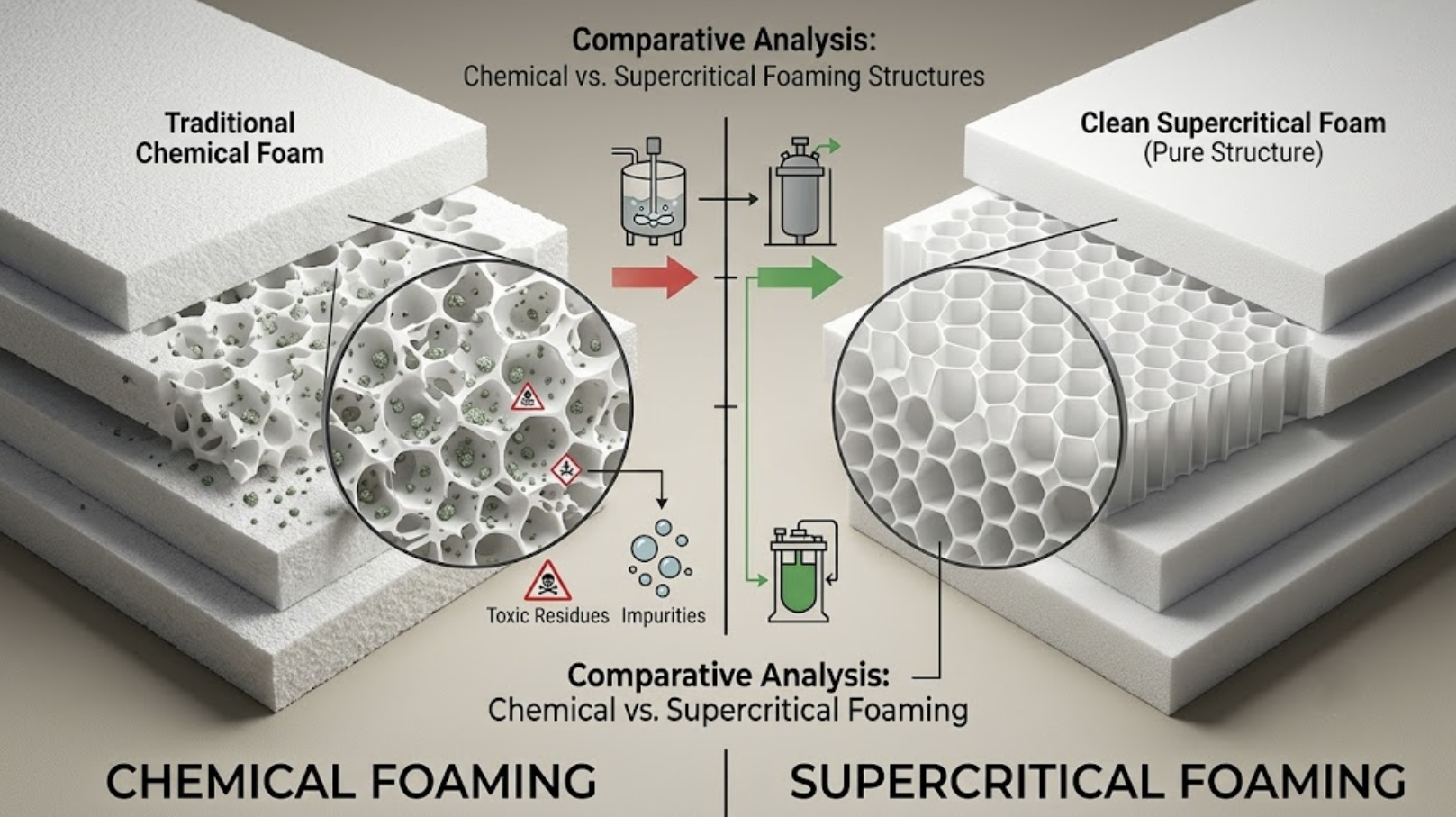
Traditional foam manufacturing relies heavily on chemical blowing agents like azodicarbonamide to expand polymer chains. During thermal processing, these chemical additives decompose rapidly to generate expanding gases. However, this aggressive chemical breakdown leaves behind corrosive organic residues, toxic decomposition byproducts, and high concentrations of volatile organic compounds. Over time, these chemical remnants cause noticeable off-gassing, material discoloration, and potential skin irritation for end consumers. Furthermore, traditional chemical foaming generates hazardous waste streams that complicate factory environmental compliance and raise global sustainability concerns.
Supercritical physical foaming completely eliminates chemical decomposition by utilizing pure physical state transitions. Processing equipment injects inert gases like nitrogen (N2) or carbon dioxide (CO2) directly into molten polymer matrices under ultra-high pressure and temperature. In this supercritical state, the gas behaves as a dense fluid that dissolves seamlessly throughout the polymer melt. When the system rapidly releases pressure, the dissolved gas expands purely through thermodynamic phase change. This clean physical process leaves zero toxic residues, zero chemical blowing agents, and zero volatile organic compounds in the finished component. As a result, manufacturing facilities maintain cleaner production environments while footwear brands deliver fully non-toxic, eco-compliant footbed solutions to global markets.
Q2: Why Does Microcellular Bubble Density Outperform Traditional Cell Expansion in Precision Footwear Engineering?
The physical difference between traditional foams and supercritical materials becomes immediately obvious under microscopic inspection. Chemical foaming creates irregular, macrocellular gas pockets with thick, uneven cell walls and wide size distributions. These erratic structural voids weaken the overall polymer matrix, leading to inconsistent local density and unpredictable energy distribution under load. When athletes apply localized pressure, the large, weak cell walls collapse easily. This structural breakdown causes premature cushioning failure, localized thinning, and reduced energy return during active wear.
In contrast, supercritical physical foaming creates billions of densely packed, microcellular closed bubbles measuring only a few micrometers in diameter. The rapid thermodynamic pressure drop causes simultaneous gas nucleation across the entire polymer volume. This uniform microcellular matrix allows engineers to achieve precise density control, reducing total material weight by up to forty percent without causing structural collapse. Leading technical foam manufacturer Foamwell utilizes this precision processing across its supercritical ethylene-vinyl acetate (EVA) and specialized Crit-X high-elastic series. The resulting microcellular architecture delivers a perfectly balanced weight-to-support ratio, allowing athletic footwear to remain exceptionally light while maintaining uniform cushioning across the entire footbed surface.
Q3: What Scientific Mechanisms Give Supercritical Foams Superior Resistance to Dynamic Compression Set?
A major limitation of traditional footwear cushioning involves the phenomenon known as compression set or “pack out.” Under repetitive impact forces, the irregular macro-cells in chemical foams experience permanent cell wall fracture and plastic deformation. As the internal cell walls collapse, the material loses its ability to rebound, leaving the footbed permanently flattened and hard after weeks of heavy use. This mechanical degradation drastically reduces shock absorption, increases joint fatigue, and shortens the functional lifespan of athletic shoes.
Supercritical foam materials prevent compression set through molecular polymer chain memory and symmetrical microcellular wall distribution. When an athlete impacts the ground, the microscopic cell walls deform elastically without structural tearing or cell wall rupture. The compressed gas within the closed micro-cells works in tandem with the elastic polymer matrix to store kinetic energy efficiently. Upon load release, the symmetrical micro-cells spring back instantaneously to their original dimensions. Advanced polymer platforms like supercritical Polyether Block Amide (PEBA) demonstrate this mechanism effectively, delivering energy return metrics exceeding eighty percent. The uniform microcellular walls distribute mechanical stress evenly across the entire matrix, preserving original thickness and rebounding capability over hundreds of miles of dynamic athletic wear.
Q4: How Can Footwear Brands Transition from Legacy Foam Components to Custom Supercritical Solutions?
Transitioning from legacy chemical foams to advanced physical supercritical materials requires careful engineering alignment across material selection, mold design, and performance tuning. Footwear developers often face challenges regarding hardness variations, custom footbed geometries, and specific energy restoration requirements for different sport categories. Successfully adopting supercritical technology demands close collaboration with specialized component manufacturers capable of executing precise chemical formulation adjustments and rapid prototyping.
Foamwell simplifies this transition through comprehensive original equipment manufacturing (OEM) and original design manufacturing (ODM) capabilities. Technical specialists collaborate directly with footwear development teams to fine-tune polymer blends, Shore C hardness levels, and anatomical support features. Utilizing advanced gas-injection equipment and rapid 3D prototyping tools, the engineering team quickly transforms initial footwear concepts into fully functional, tested component samples. Furthermore, robust ISO-certified quality management systems ensure that high-volume production runs match exact laboratory prototypes. This integrated customization framework enables footwear brands to upgrade product performance seamlessly without extending product development cycles.
Summary: Evaluating Supercritical Technology for Next-Generation Footwear Lines
The clear advantages of supercritical physical foaming make it a transformative technology for the modern footwear industry. By replacing toxic chemical expansion with clean inert gas phase transitions, footwear brands achieve superior environmental cleanliness, precise microcellular density control, and exceptional resistance to dynamic compression set. Integrating these advanced material platforms allows footwear developers to meet growing consumer demands for high-performance, durable, and eco-responsible athletic shoes.
Footwear brand executives, product managers, and sourcing directors seeking to explore advanced supercritical EVA, PEBA, and Crit-X customized component solutions can review technical specifications and request development inquiries at https://www.foam-well.com/.
Foamwell Limited
Foamwell Limited
+ +86 13549380132
email us here
Legal Disclaimer:
EIN Presswire provides this news content “as is” without warranty of any kind. We do not accept any responsibility or liability
for the accuracy, content, images, videos, licenses, completeness, legality, or reliability of the information contained in this
article. If you have any complaints or copyright issues related to this article, kindly contact the author above.

Media gallery
