
New Waveguide Coupling Method Enables Optical Power Splitting at Arbitrary Ratios
SHANNON, CLARE, IRELAND, November 10, 2026 /EINPresswire.com/ -- Announcing a new publication from Opto-Electronic

Press Release Disclaimer: This is a press release distributed through the XPR Media network. It has not been independently verified by our newsroom.

SHANNON, CLARE, IRELAND, November 10, 2026 /EINPresswire.com/ — Announcing a new publication from Opto-Electronic Advances; DOI 10.29026/oea.2026.260026.
By manipulating the propagation, coupling and interference of light at the micro- and nanoscale, integrated photonic chips can provide high-speed communication, beam steering, optical computing, sensing and detection, and are an essential hardware foundation for next-generation information technology. In such chips, the evanescent-field coupling between waveguides is the core mechanism underlying on-chip splitting, routing and phased-array beam control. In high-density photonic integration, however, reducing the waveguide spacing produces pronounced crosstalk, and conventional evanescent coupling also suffers from strong wavelength dispersion, which limits the operating bandwidth of the devices. These problems have long constrained the development of ultra-dense photonic chips, broadband beam-steering devices and high-capacity spatial multiplexing systems.
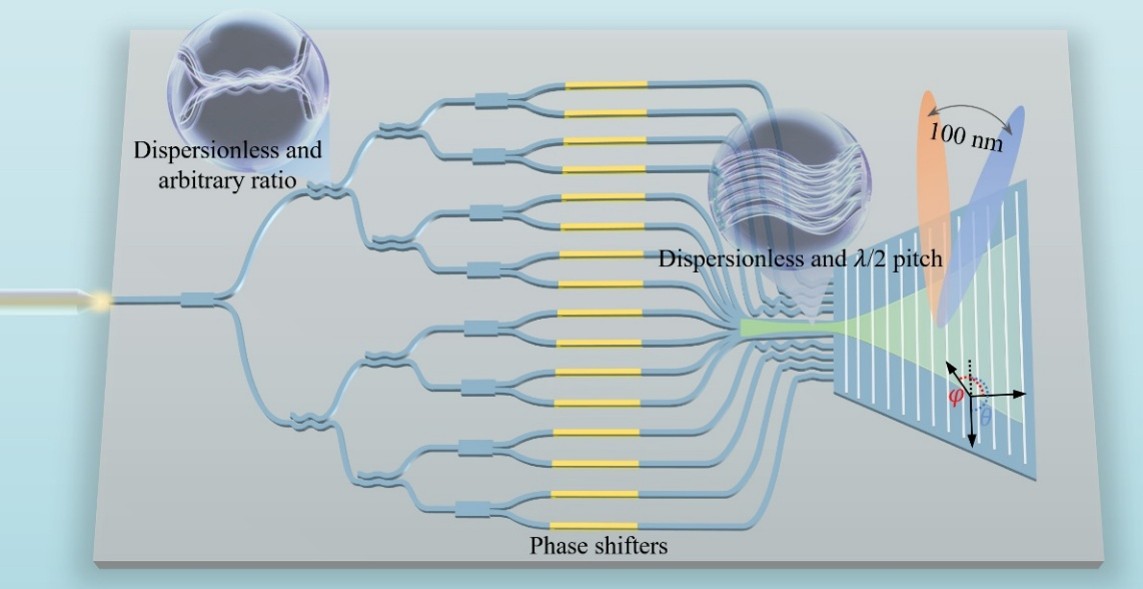
To address this challenge, Prof. Yi Zou’s group at the School of Information Science and Technology, ShanghaiTech University, proposed an on-chip coupling control method based on artificial gauge fields (AGFs), achieving broadband, low-crosstalk ultra-dense waveguide arrays as well as dispersionless on-chip power splitters with arbitrary splitting ratios. The results were published under the title “Dispersionless coupling control enabled by artificial gauge fields for dense waveguide arrays and arbitrary-ratio power splitters” in Opto-Electronic Advances, 2026, Issue 10.
In this work, the team designed and fabricated ultra-dense waveguide arrays with a center-to-center pitch of only 750 nm on a silicon-on-insulator platform. This pitch is about half the optical wavelength in the telecom band and far smaller than the typical crosstalk-limited spacing of conventional waveguide arrays. Experiments show that the array suppresses crosstalk to below –20 dB over a 100 nm broadband range from 1500–1600 nm while introducing almost no additional propagation loss, offering a new design approach for high-density on-chip optical interconnects, compact delay lines and wide-field-of-view optical phased arrays.
Beyond suppressing unwanted coupling, the team further used artificial gauge fields to actively engineer on-chip coupling. By tuning the amplitude of the waveguide trajectory modulation and the coupling length, they built near-dispersionless directional couplers that maintain a stable power splitting ratio over a broad wavelength range. In experiments, splitters with arbitrary ratios such as 60:40 and 70:30 were realized, and their good wavelength independence was verified over 1500–1600 nm. These results show that artificial gauge fields can be used not only to suppress coupling but also to precisely design and compensate the dispersion of conventional couplers, so that broadband optical signals are distributed and transmitted on chip in a designed manner.
Building on these techniques, the team further demonstrated their application in a two-dimensional optical phased array. An optical phased array steers a light beam through on-chip control, acting as a “beam scanner without mechanical moving parts”, and holds strong application prospects in LiDAR, 3D imaging, autonomous driving and space communications. By cascading near-dispersionless splitters, the researchers achieved a broadband Gaussian-weighted intensity distribution in a 32-channel array, effectively reducing the far-field sidelobes. The experiments show that the two-dimensional optical phased array achieves a field of view of 120° × 14.5° and a sidelobe level below –17 dB near the main beam direction. These results confirm the potential of artificial-gauge-field coupling control for wide-field-of-view, low-sidelobe on-chip beam steering.
This work presents a new coupling control scheme for high-density photonic chips. Through the co-design of artificial gauge fields and waveguide structures, low crosstalk, high-density integration, broadband operation and flexible splitting can be achieved simultaneously, providing a new technological path toward smaller and higher-performance photonic chips.
Keywords: artificial gauge fields, waveguide, integrated photonics
# # # # # #
The group of Prof. Yi Zou at the School of Information Science and Technology, ShanghaiTech University (Optoelectronic Chip Laboratory), targets high-performance, low-power and highly integrated optoelectronic information systems and focuses on integrated photonic chips and photonic integrated circuits. Its main directions include high-density on-chip optical interconnects, programmable and topological photonic integrated circuits, optical computing and spectral analysis, optical sensing, and cryogenic electro-optic and acousto-optic devices, forming a complete research chain from new physical mechanisms to novel structures, high-performance devices, system verification and application extension. In recent years, the group has published more than 90 papers in international journals such as Nature Communications, Opto-Electronic Advances, Physical Review Letters, Laser & Photonics Reviews, Applied Physics Reviews, Nano Letters and Advanced Functional Materials, together with more than 60 conference papers. The group undertakes projects funded by the National Natural Science Foundation of China, the Shanghai Major Special Projects, the Strategic Priority Research Program of the Chinese Academy of Sciences and provincial and ministerial key R&D programs, and collaborates extensively with universities and research institutes in China and abroad.
# # # # # #
Opto-Electronic Advances (OEA) is a high-impact, open access, peer reviewed SCI journal with an impact factor of 22.4 (Journal Citation Reports 2024). OEA has been indexed in SCI, EI, DOAJ, Scopus, CA and ICI databases, and expanded its Editorial Board to 41 members from 17 countries.
# # # # # #
More information: http://www.oejournal.org/oea
Editorial Board: http://www.oejournal.org/oea/editorialboard/list
All issues available in the online archive (http://www.oejournal.org/oea/archive).
Submissions to OEA may be made using ScholarOne (https://mc03.manuscriptcentral.com/oea).
ISSN: 2096-4579
CN: 51-1781/TN
Contact Us: oea@ioe.ac.cn
Twitter: @OptoElectronAdv (https://twitter.com/OptoElectronAdv?lang=en)
WeChat: OE_Journal
# # # # # #
Li T, Zhang H, Sun YH et al. Dispersionless coupling control enabled by artificial gauge fields for dense waveguide arrays and arbitrary-ratio power splitters. Opto-Electron Adv 9, 260026 (2026). DOI: 10.29026/oea.2026.260026
Opto-Electronic Advances Editorial Office
Opto-Electronic Advances
oea@ioe.ac.cn
Legal Disclaimer:
EIN Presswire provides this news content “as is” without warranty of any kind. We do not accept any responsibility or liability
for the accuracy, content, images, videos, licenses, completeness, legality, or reliability of the information contained in this
article. If you have any complaints or copyright issues related to this article, kindly contact the author above.

Media gallery


