
TrustHouse.AI Advances Unified AI Trust and Context Infrastructure to Address the Challenge in Enterprise AI Adoption
Data context defines what AI knows. Business context explains meaning. Process context guides operations. Trust ensures

Press Release Disclaimer: This is a press release distributed through the XPR Media network. It has not been independently verified by our newsroom.
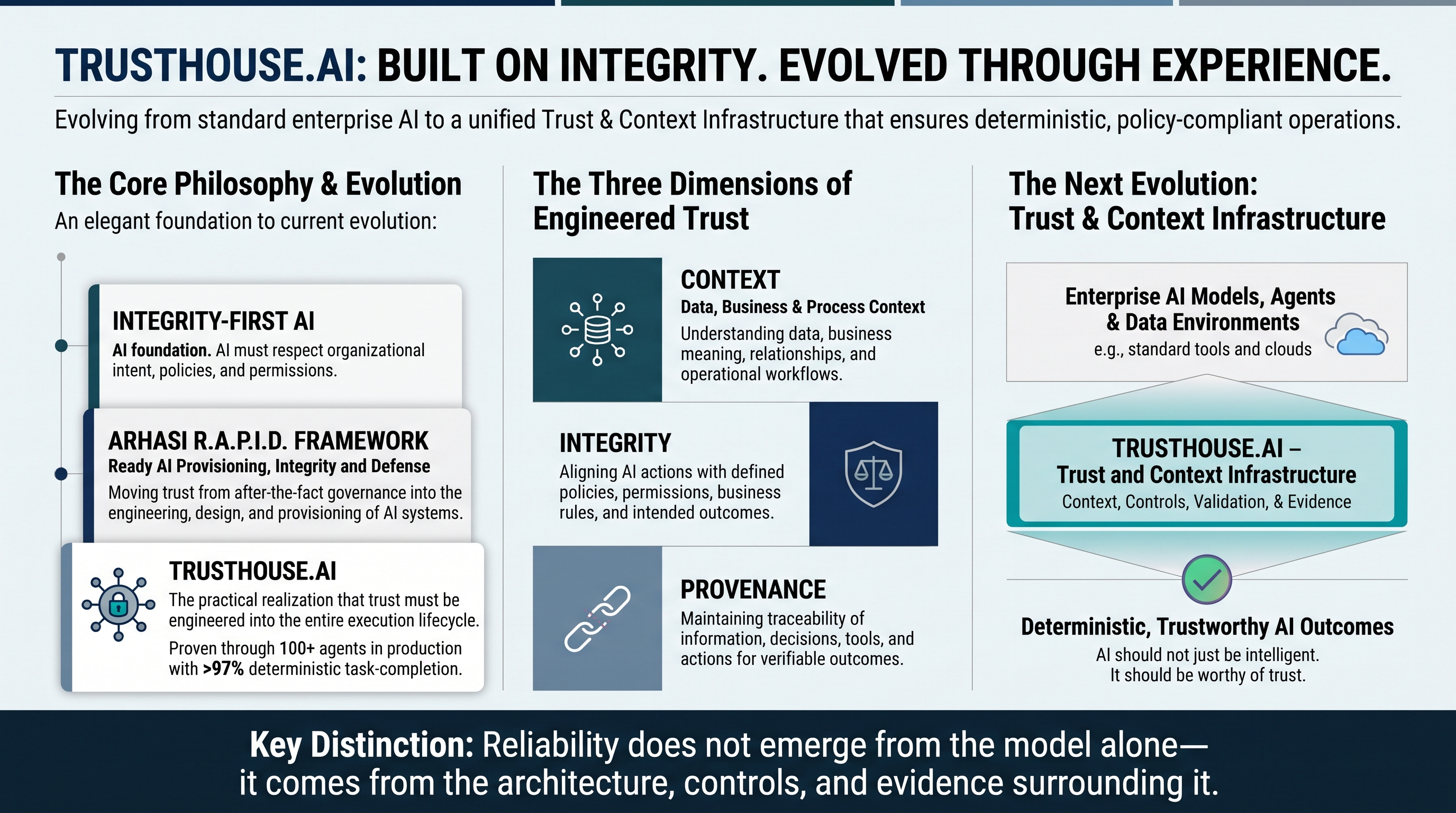

Data context defines what AI knows. Business context explains meaning. Process context guides operations. Trust ensures responsible AI action.
FRISCO, TX, UNITED STATES, November 3, 2026 /EINPresswire.com/ — Company brings together data, business, and process context with integrity-first governance to help enterprises deploy accountable, reliable, and operationally trusted AI.**
As enterprises accelerate the adoption of artificial intelligence, TrustHouse.AI is advancing a unified approach to AI Trust and Context Infrastructure designed to address one of the industry’s emerging challenges: enabling AI systems to understand how businesses operate and ensuring their actions remain reliable, governed, and accountable.
While much of the enterprise AI market has focused on increasingly capable models, data integration, knowledge graphs, and retrieval technologies, TrustHouse.AI believes the next evolution requires a broader foundation—one that connects organizational knowledge with business meaning, operational processes, and verifiable trust.
The company’s approach recognizes three interconnected dimensions of enterprise context:
– Data Context: Understanding what an organization knows through its enterprise data, documents, metadata, relationships, knowledge graphs, and information lineage.
– Business Context: Understanding what that information means within the organization, including business terminology, customer relationships, contractual obligations, policies, regulatory requirements, and decision frameworks.
– Process Context: Understanding how the organization operates through workflows, responsibilities, approvals, dependencies, exceptions, and execution requirements.
TrustHouse.AI believes these dimensions must operate within an integrated trust framework encompassing governance, security, permissions, provenance, validation, and operational accountability.
“Enterprise AI needs more than access to information. It needs an understanding of how the business works, why decisions are made, and what actions it is permitted to take. Context and trust cannot be treated as separate capabilities. They must be engineered together,” said **Chiru Bhavansikar, Founder of TrustHouse.AI.
### From Integrity-First AI Principles to Production Infrastructure
TrustHouse.AI’s approach is rooted in an Integrity-First AI philosophy developed through Arhasi’s engineering and enterprise AI experience. These principles evolved into the R.A.P.I.D. framework, which translates integrity principles into practical engineering disciplines for provisioning, securing, governing, and operating AI systems.
Building on this foundation, TrustHouse.AI brings together AI governance, contextual intelligence, security, deterministic execution controls, and operational assurance.
The company’s production experience includes deployments involving more than 100 AI agents and reported deterministic task-completion rates exceeding 97%, demonstrating its focus on reliable AI execution in enterprise environments.
### Industry-Centric Context for Enterprise AI
TrustHouse.AI’s approach recognizes that enterprise context cannot be standardized entirely across industries. Financial services, healthcare, manufacturing, and supply chains each operate through distinct business semantics, regulatory obligations, risk models, and operational processes.
By connecting industry-specific context with enterprise governance and execution controls, TrustHouse.AI aims to help organizations move beyond information retrieval and isolated AI assistants toward AI systems capable of participating responsibly in business operations.
### Advancing the Next Phase of Enterprise AI
As organizations move from AI experimentation to autonomous agents interacting with enterprise applications and business-critical systems, the ability to establish the origin of information, validate business context, enforce permissions, and trace decisions becomes increasingly important.
TrustHouse.AI is advancing its unified AI Trust and Context Infrastructure around this principle: context should be understood, governed, verified, and operationalized throughout the AI lifecycle, not merely assembled at the prompt or retrieval layer.
“The future of enterprise AI will not be determined by model intelligence alone. It will depend on whether organizations can trust AI to operate within their business context. Our vision is to make trust an integral part of how enterprise AI understands, decides, and acts,” added Bhavansikar.
### About TrustHouse.AI
TrustHouse.AI is an AI Trust and Context Infrastructure built on Integrity-First AI principles and evolved from Arhasi’s R.A.P.I.D. framework. Combining contextual intelligence, governance, security, provenance, and deterministic execution controls, TrustHouse.AI helps enterprises establish the foundations for reliable and accountable AI operations. Its mission is to enable organizations to move beyond AI experimentation toward trusted enterprise intelligence, where context informs decisions, integrity governs actions, and outcomes can be validated and traced.
Chiru Bhavansikar
TrustHouse.AI (dba Arhasi Inc)
+1 214-302-7147
Visit us on social media:
LinkedIn
YouTube
AI TrustOps
Legal Disclaimer:
EIN Presswire provides this news content “as is” without warranty of any kind. We do not accept any responsibility or liability
for the accuracy, content, images, videos, licenses, completeness, legality, or reliability of the information contained in this
article. If you have any complaints or copyright issues related to this article, kindly contact the author above.

Media gallery

